Latest News

Types of Solar Panels in the UAE (2026): Pros, Cons, and Which to Choose

Solar panel guide

The UAE gets some of the strongest sunshine in the world. That makes solar a sensible choice for villas, offices and warehouses. But not every panel performs the same here. Heat, dust and roof space all affect which type gives you the best return.

This guide compares the main types of solar panels, their advantages and disadvantages, and which one fits a home and which one fits a business.

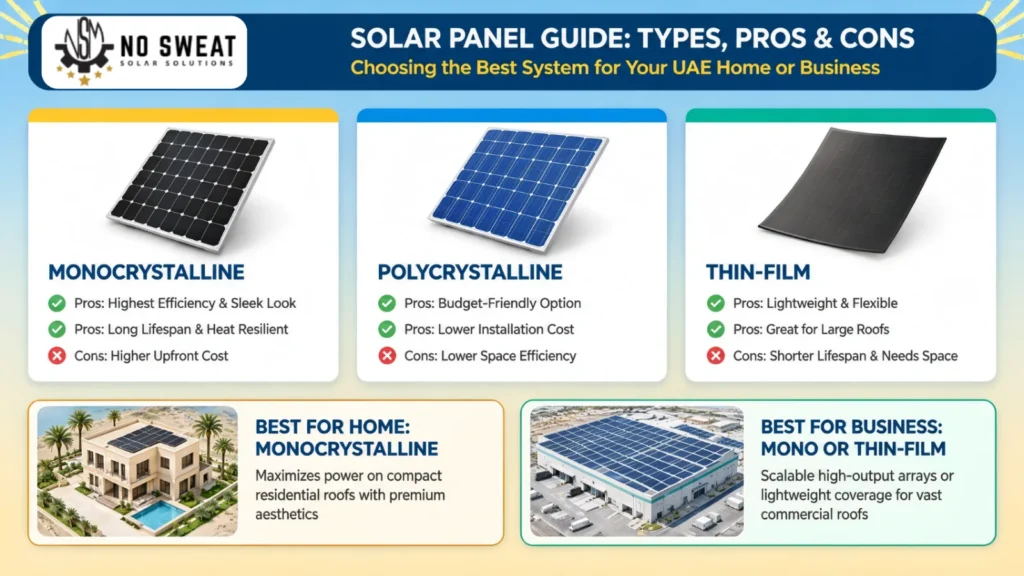
The Three Main Types of Solar Panels

1. Monocrystalline Solar Panels

Monocrystalline panels are made from a single silicon crystal. They are usually black and have a uniform look.

Advantages

  • Highest efficiency, typically around 20–23%
  • More power from less roof space
  • Better performance in high heat than most alternatives
  • Long lifespan, usually 25–30 years
  • Clean, modern look that suits villas

Disadvantages

  • Higher upfront cost than other types
  • Output still drops on very hot days, as with all panels

2. Polycrystalline Solar Panels

Polycrystalline panels are made from many silicon fragments melted together. They are usually blue and speckled.

Advantages

  • Lower upfront cost
  • Reliable and proven technology
  • A good fit for large roofs where space is not a problem

Disadvantages

  • Lower efficiency, typically around 15–17%
  • Need more space for the same output
  • Lose more output in heat than monocrystalline panels
  • Less common today, as monocrystalline prices have come down

3. Thin-Film Solar Panels

Thin-film panels are made by layering photovoltaic material on glass, metal or plastic. They are light and can be flexible.

Advantages

  • Lightweight, which helps on roofs that can’t carry heavy loads
  • Flexible options for unusual surfaces
  • Perform relatively well in heat and low light

Disadvantages

  • Lowest efficiency, typically around 10–13%
  • Need the most space
  • Shorter lifespan in many products, often 10–20 years

Newer Cell Technologies Worth Knowing

You will also see terms like PERC, TOPCon and bifacial. These are not separate panel types. They are upgrades to monocrystalline cells.

  • PERC and TOPCon add layers that capture more light, so efficiency and heat tolerance improve.
  • Bifacial panels collect light on both sides. They work best on flat roofs, carports and ground mounts with reflective surfaces.

Solar Panel Types at a Glance

 MonocrystallinePolycrystallineThin-Film
Typical efficiency20–23%15–17%10–13%
Lifespan25–30 years25 years10–20 years
Heat performanceBestModerateGood
Space neededLeastMoreMost
Upfront costHigherLowerVaries
Best forVillas, most roofsLarge, budget-led roofsLight roofs, special surfaces

Figures are typical ranges. Always check the datasheet of the exact panel.

What Matters Most for UAE Conditions

Heat. Panels lose output as they get hotter. The temperature coefficient on the datasheet shows how much. A lower number is better.

Dust and sand. Dirt blocks sunlight. Plan for regular cleaning, whatever type you choose.

Humidity and coastal air. Near the coast, look for panels with proven corrosion and salt-mist resistance.

Roof space. If space is tight, higher efficiency matters more than a lower price.

Which Solar Panel Is Best for a Home?

For most villas and homes, monocrystalline panels are the best choice.

  • Roof space is limited, so you need the most power per square metre.
  • High efficiency and better heat tolerance suit UAE summers.
  • Black panels look cleaner on a villa roof.
  • The longer lifespan spreads the cost over more years.

Consider a PERC or TOPCon monocrystalline panel if you want the best performance from a small roof.

Grid connection. In Dubai, the Shams Dubai programme lets eligible customers connect rooftop solar to the grid and offset their consumption with net metering. Rules differ between emirates, so confirm the requirements before you install.

Which Solar Panel Is Best for a Business?

The answer depends on the building and how it uses power.

  • Offices and retail: monocrystalline, for the same reasons as homes, especially when roofs are small.
  • Warehouses and factories with large roofs: monocrystalline for the highest yield, or a lower-cost option when the budget leads and space is plentiful.
  • Flat roofs, carports and ground mounts: bifacial monocrystalline panels can add extra output from reflected light.
  • Light or weak roofs: thin-film can work where weight is a limit.

Businesses should also look at daytime power use. Solar pays back fastest when most of your consumption happens while the sun is up.

How to Choose the Right Panel: A Quick Checklist

  1. Measure your roof. Space, shading and orientation set the limit on how much you can install.
  2. Review your bills. Your consumption decides the system size.
  3. Set a budget and a payback target. Balance upfront cost against years of savings.
  4. Check the datasheet. Compare efficiency, temperature coefficient and degradation rate.
  5. Compare warranties. Look at both the product warranty and the performance warranty.
  6. Choose a quality installer. Good design and installation matter as much as the panel itself.

Recommended Panel Types by Situation

SituationRecommended type
Villa with limited roof spaceMonocrystalline (PERC or TOPCon)
Apartment building or small officeMonocrystalline
Large warehouse or factory roofMonocrystalline, or polycrystalline on a tight budget
Flat roof, carport or ground mountBifacial monocrystalline
Light or unusual surfaceThin-film

Get Advice from No Sweat Solar

The right panel depends on your roof, your consumption and your goals. No Sweat Solar designs and installs solar systems for homes and businesses in the UAE. [Add one or two verified points, such as years of experience, installed capacity, warranties or certifications.]

Ready to find out what suits your property? Contact No Sweat Solar for a site assessment and a system recommendation at https://nosweatsolar.ae/.

Frequently Asked Questions

Which type of solar panel is best for UAE heat?
Monocrystalline panels are usually the best fit. They have higher efficiency and a lower temperature coefficient than polycrystalline panels, so they lose less output when roof temperatures climb. Check the temperature coefficient on the datasheet and choose the lower figure.

Are monocrystalline panels worth the extra cost?
For most homes, yes. They produce more power per square metre, which matters when roof space is limited. On a large roof with a tight budget, polycrystalline or lower-cost monocrystalline panels can still make sense.

How long do solar panels last in the UAE?
Quality monocrystalline and polycrystalline panels typically carry 25-year performance warranties and often keep working for 25 to 30 years. Output declines slowly each year. Heat, dust and installation quality all affect real-world lifespan.

Do dust and sand reduce solar panel output?
Yes. Dust and sand block sunlight and can cut output noticeably between cleanings. Regular cleaning keeps production close to its expected level. Cleaning frequency depends on your location and how dusty the area is.

How many solar panels does a villa need?
It depends on your electricity use, roof space and the wattage of each panel. A site assessment that compares your electricity bills with your roof area gives the right number.

Which solar panels are best for a business or warehouse?
Monocrystalline panels suit most commercial rooftops because they deliver the highest yield per square metre. Thin-film panels can suit very large or lightweight roofs, and bifacial panels work well on flat roofs with reflective surfaces. The best choice depends on roof strength, daytime power use and budget.

Can I sell extra solar power back to the grid in the UAE?
In Dubai, eligible customers can connect rooftop solar to the grid through the Shams Dubai programme and offset their consumption with net metering. Rules and approvals differ between emirates, so confirm requirements with your local utility before installing.

Make a Comment

Your email address will not be published. Required field are marked*

Cart (0 items)
Select the fields to be shown. Others will be hidden. Drag and drop to rearrange the order.
  • Image
  • SKU
  • Rating
  • Price
  • Stock
  • Availability
  • Add to cart
  • Description
  • Content
  • Weight
  • Dimensions
  • Additional information
Click outside to hide the comparison bar
Compare